30 seconds summary
- Resilient teams aren’t just tough, they’re designed to adapt. Change management helps people move through uncertainty by clarifying the “why,” involving stakeholders, addressing resistance, and reinforcing new behaviors.
- Systems thinking adds the ability to see the organization as an interconnected system, where bottlenecks, incentives, decision rights, and feedback loops drive outcomes more than individual effort. When you combine both, you don’t just roll out change; you redesign the conditions that make resilience possible: clear priorities, manageable workload, fast learning cycles, psychological safety, and strong cross-team coordination.
- The result is a team that detects problems earlier, learns faster, and keeps delivering even when the environment keeps shifting.
Resilient teams aren’t just teams that “handle stress well.” They’re teams that keep delivering value when priorities shift, technologies evolve, leadership changes, or markets wobble. They don’t merely survive disruption; they adapt in ways that preserve trust, performance, and learning. In most organizations, resilience is treated as a people issue, hire better, train harder, communicate more. But resilience is also a design issue. It depends on how work flows, how decisions are made, how incentives shape behavior, and how the organization responds to feedback.
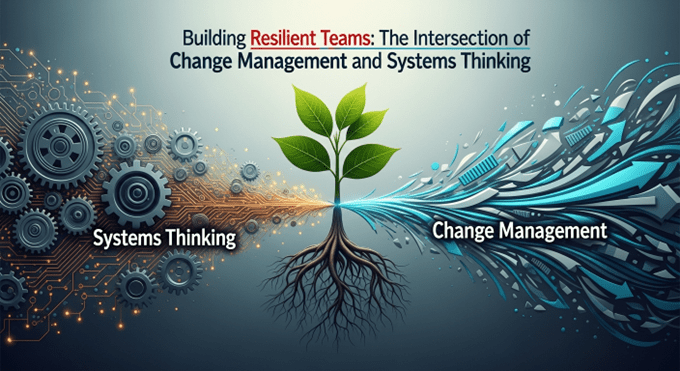
That’s where the intersection of change management and systems thinking becomes powerful. Change management provides the discipline to move people and organizations from a current state to a desired future state with intention and care. Systems thinking provides the lens to understand the organization as an interconnected whole, where cause and effect are often delayed, circular, and counterintuitive. When you combine them, you get a practical way to build teams that can absorb shocks without breaking and evolve without burning out.
Why resilience is hard to “train” into teams
Many resilience initiatives focus on individuals: mindfulness workshops, stress management, grit training, and time management. These can help, but they often fail because they don’t change the conditions generating strain. If a team is facing constant reprioritization, unclear decision rights, overloaded backlogs, conflicting incentives, and opaque leadership communication, personal coping strategies become a band-aid. People may become more tolerant of dysfunction rather than less exposed to it.
Team resilience emerges from patterns: how the team coordinates under uncertainty, how it handles conflict, how it learns from failure, and how it anticipates downstream effects of local decisions. These patterns aren’t random; they are shaped by the system the team operates in. Therefore, building resilience requires both the “human journey” of change (the domain of change management) and the “system design” of work and feedback loops (the domain of systems thinking).
Change management: moving people through uncertainty with intention
At its core, change management is about enabling adoption. You can implement new processes, tools, and organizational charts, but if people don’t understand, accept, and integrate them into daily work, the change is superficial. Good change management does a few key things:
- Clarifies the purpose and narrative. People can endure a lot when they understand the “why.” They struggle when change feels arbitrary or political.
- Builds sponsorship and shared ownership. Change requires visible commitment from leaders and meaningful involvement from the people who do the work.
- Designs communication as a two-way channel. Broadcast updates are not enough; teams need ways to surface concerns, question assumptions, and influence decisions.
- Anticipates resistance as information. Resistance is often framed as an obstacle, but it frequently signals misalignment, missing capability, or unintended consequences.
- Creates reinforcement mechanisms. If performance metrics, incentives, and leadership behaviors contradict the new direction, people revert to old habits.
Change management is strongest when change is relatively bounded: a new CRM, a shift in workflow, a reorganization with clear objectives. But modern organizations increasingly face continuous change, many overlapping initiatives, ambiguous endpoints, and evolving strategies. In this environment, linear “plan and roll out” approaches can be overwhelmed. Teams need the capacity to adapt continuously, not just comply once.
The intersection: why combining both disciplines matters
Change management without systems thinking can become performative. You might run communication campaigns, training sessions, and stakeholder meetings, yet still fail because the underlying system produces the same old outcomes. People may be “aligned” in presentations, but daily work keeps pushing them into overload and reactive behavior.
Systems thinking without change management can become academic. You might map causal loops, identify root causes, and propose elegant interventions—yet struggle to gain adoption because you overlooked trust, fears, politics, capacity constraints, and the emotional reality of change.
Together, they create a balanced approach:
- Systems thinking helps you choose the right change (and avoid fixing symptoms).
- Change management helps you implement the change in a way humans can absorb (and avoid well-designed solutions that no one uses).
- Both together help build teams that can not only handle a specific transformation, but also improve their ability to navigate the next one.
What resilience looks like in practice
A resilient team is not a team that never struggles. It’s a team that:
- Detects early signals of trouble (risk, overload, misalignment).
- Discusses problems without blame.
- Adjusts plans based on feedback and new information.
- Maintains psychological safety while still holding high standards.
- Learns systematically, capturing insights and changing behaviors.
- Coordinates across dependencies without constant escalation.
- Protects energy and focus through boundaries and prioritization.
These capabilities are not traits; they are outcomes of systems and practices.
A systems-informed change approach to building resilient teams
Below are core practices that sit directly at the intersection of change management and systems thinking.
1) Start with “value flow,” not just org charts
When resilience is low, work often moves in fits and starts: waiting for approvals, unclear handoffs, bottlenecks, dependency thrash. Teams feel busy but ineffective. A systems lens asks: Where does value actually flow, and where does it stall?
Map the end-to-end flow of a typical piece of work—from request to delivery to learning from outcomes. Identify delays, rework, and loops. Then apply change management: involve the people who live the process, make the case for why redesign matters, and create quick wins that show improvement.
Resilient teams have cleaner flows and fewer hidden queues. They don’t rely on heroics because the system supports progress.
2) Treat resistance as a diagnostic tool
In many transformations, leaders interpret resistance as a mindset problem: “They don’t get it.” Systems thinking reframes resistance as data: “What about the system makes this change feel unsafe, costly, or pointless?”
Common systemic drivers of resistance include:
- Incentives that reward the old behavior.
- Lack of time to learn new practices (change added on top of existing load).
- Previous failed initiatives that eroded trust.
- Misalignment between stated priorities and actual decisions.
Change management provides the methods to surface resistance (listening sessions, stakeholder interviews, pulse surveys) and respond in ways that build credibility. Systems thinking helps you interpret the resistance as signals of misfit between the change and the system.
3) Build feedback loops that are fast, honest, and safe
Resilience depends on feedback. Teams need to know whether they’re succeeding, drifting, or failing early enough to adjust. Yet many organizations have slow, distorted feedback loops: quarterly metrics, filtered status reports, and retrospective blame.
Design feedback loops intentionally:
- Shorten cycle times (ship smaller increments, review sooner).
- Make outcomes visible (dashboards, customer insights, defect trends).
- Create “no penalty” channels for raising risks early.
- Link learning to action (retrospectives that produce real changes).
This is classic systems thinking, improving the quality and speed of feedback loops. But it requires change management to address the human side: people must trust that honesty won’t be punished and that speaking up leads to improvement, not blame.
4) Reduce structural overload—resilience cannot exist in permanent saturation
A team running at 110% capacity all the time is brittle. In systems terms, it has no slack, so small disruptions cascade into crises. Overload creates delayed effects: quality drops later, burnout appears later, and turnover hits when it’s most painful.
Resilience requires structural choices:
- Limit work in progress.
- Protect focus time.
- Make prioritization explicit and ruthless.
- Align demand with capacity.
Change management is vital here because overload is often politically reinforced. Every stakeholder believes their work is urgent. Building resilient teams means changing how the organization says “no,” how it sequences commitments, and how leaders model trade-offs.
5) Clarify decision rights to prevent escalation storms
When decision-making is unclear, teams waste energy in meetings, approvals, and second-guessing. They escalate conflicts that could have been solved locally. Systems thinking sees unclear decision rights as a structure that creates delays and frustration.
A resilience-building intervention is to define:
- What decisions the team can make autonomously.
- What decisions require cross-team agreement.
- What decisions require leadership input.
- The principles used to decide (e.g., customer impact, risk, regulatory constraints).
Then change management ensures these agreements stick: leaders must respect them, teams must practice them, and exceptions must be handled transparently.
The role of cross-functional alignment and “systemic empathy”
One of the most practical benefits of systems thinking is that it builds what you might call systemic empathy, the ability to understand how other teams’ constraints shape their behavior. A product team learns why security reviews take time. A compliance team learns how late changes amplify engineering risk. A sales team learns how discount commitments affect delivery timelines.
This empathy is not just emotional; it’s operational. It reduces blame and enables better coordination. Change management can accelerate this by convening cross-functional workshops, aligning on shared measures of success, and making interdependencies visible.
Organizations sometimes bring in outside expertise, anything from internal transformation offices to an external systems thinking consultancy, to facilitate these mappings and help teams see patterns they’re too close to notice. The key is not the diagram; it’s the shared understanding and the commitment to change the structures creating recurring pain.
A practical framework: Resilience as capability + conditions
If you want a simple way to diagnose and build resilient teams, think in two parts:
- Capabilities (what the team can do):
- Adapt plans quickly
- Communicate clearly under pressure
- Resolve conflict productively
- Learn from failure
- Coordinate across boundaries
- Conditions (what the system enables):
- Clear priorities and decision rights
- Manageable workload and slack
- Fast, reliable feedback loops
- Incentives aligned to collaboration and quality
- Psychological safety and trust
Change management strengthens capabilities through involvement, communication, training, and reinforcement. Systems thinking improves conditions by redesigning workflows, decision structures, and feedback loops. Build both, and resilience becomes a stable property of the team, not a heroic effort.
Common traps, and how to avoid them
- Trap: Over-indexing on communication.
If the system punishes the desired behavior, no amount of messaging will sustain change. Align metrics and incentives. - Trap: Treating resilience as toughness.
Resilience is not “endure more.” It’s “adapt better.” Often that means doing less, focusing more, and redesigning work. - Trap: Fixing symptoms instead of structures.
If firefighting is constant, don’t just add incident processes—reduce upstream causes like dependency complexity, unclear priorities, and quality shortcuts. - Trap: Making change an extra project.
If the change requires people to do their full workload plus transformation work, adoption will fail. Create capacity intentionally.
Conclusion
Building resilient teams is not a one-time initiative or a personality trait. It’s an ongoing practice of designing environments where learning is faster than disruption. Change management brings the human discipline: how you engage people, build trust, communicate meaning, and reinforce new behaviors. Systems thinking brings the structural discipline: how you understand feedback loops, redesign workflows, and identify leverage points that make change stick.